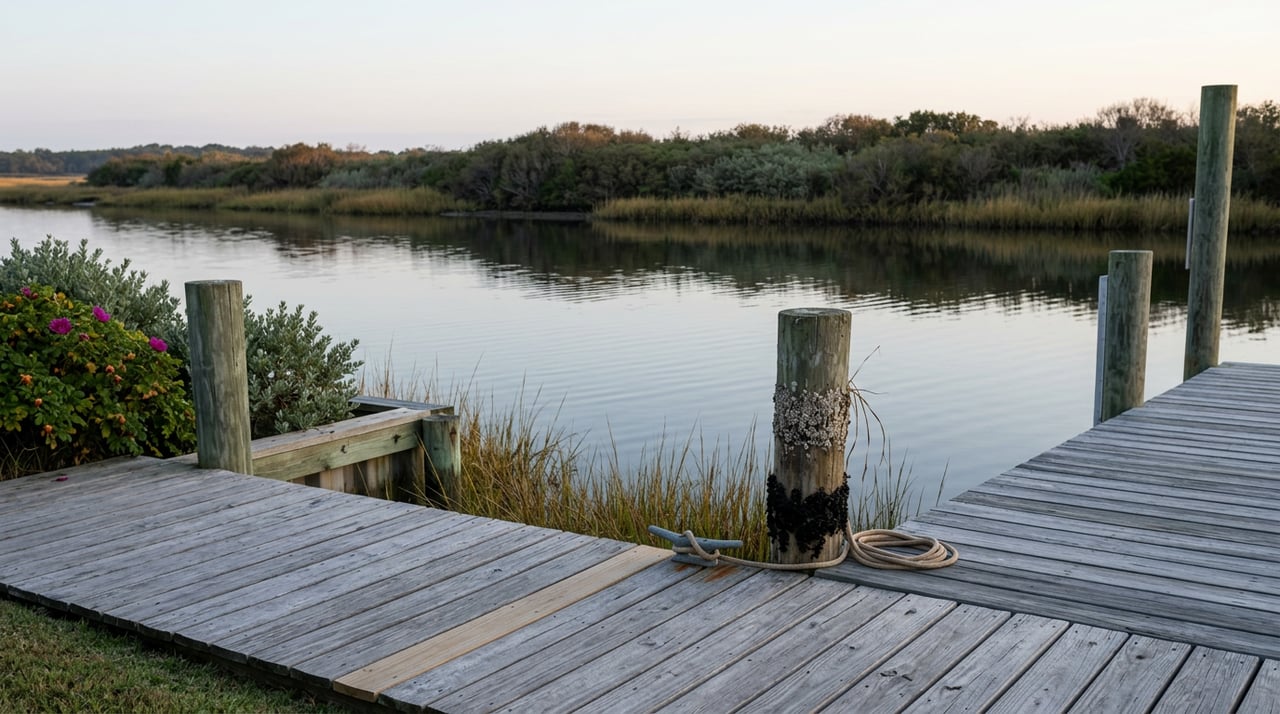
In February 2026, as Taylor K. Vecsey reported in her account of the collapse, a weathered shingled house that had stood on stilts over Napeague Harbor for more than two decades finally gave way. Ice cracked, the pilings snapped, and the structure that thousands of visitors had photographed at Lazy Point over the years slid into the water. When a reporter asked the East Hampton Town Trustees whether the site belonged to them, the deputy town clerk gave an answer that should stop any prospective waterfront buyer mid-scroll: the Trustees never owned that parcel, because the original sale of that land only extended to the mean high water mark. Once the structure became fully submerged, in his words, it stopped being intertidal and started being permanently underwater, and at that point the property, as a legal thing you can own, ceased to exist.
The Trustees' role in waterfront ownership
The East Hampton Town Trustees are not a homeowners association or an advisory board. They are an elected body whose authority traces back to the Dongan Patent of 1686.
Two permits, one project, and a town still catching up
Because of that split ownership, waterfront construction in East Hampton typically requires clearing two separate hurdles, not one. The town's own code is explicit on this point: no building permit can be issued for any activity on a beach, bluff, or underwater land the Trustees control unless the applicant has already secured a Trustee permit, or has a letter from the Trustees stating they have no jurisdiction over the project. The Building Department and the Trustees are answering two different questions, and a buyer who assumes a standard building permit covers dock or bulkhead work is going to lose months finding out otherwise.
Those months are not hypothetical right now. East Hampton's Building Department has spent much of the past year fighting a documented backlog, a handful of lawsuits, and staff turnover, including a bribery investigation that led to criminal charges against two former staffers. One Amagansett property owner sued the town in 2026 after waiting five months for a building permit on a Bendigo Road property that runs down to Napeague Bay, on top of an earlier suit that took two months of litigation just to get a hearing scheduled. The town brought on veteran building inspector Richard Normoyle last September with a stated one-year plan to work through the backlog, which stretches back well over a year in places. That is the environment a Trustee permit application often lands in before it even gets its own separate review.
The court has already ruled on what happens when a permit gets denied
Two recent State Supreme Court decisions matter here because they show how contested this permitting terrain has become, and how the rules are shifting mid-game. In one case, a homeowner on Gerard Drive was denied a natural resources special permit to renovate a house that had stood since 1971, even after offering to replace an aging cesspool with an updated septic system specifically to protect nearby wetlands. In a second case, owners of a property on Three Mile Harbor Road were denied a permit to build a new dock, in an area where no new dock had been approved in 35 years. Both denials were overturned. The presiding judges found the town's Zoning Board of Appeals had acted without evidence to support claims that the projects would cause environmental harm, and both rulings placed a heavier burden on the town to prove harm rather than on the homeowner to disprove it. The town is appealing both decisions, so the precedent is real but not yet permanently settled. For a buyer, that means the standard for winning a dock or renovation permit denial has recently become more favorable, but the process to get there still runs through a planning department that is already short-staffed and backlogged.
The Trustees are adjusting for how common this has become
The volume of repeat filings has gotten large enough that the Trustees changed their own fee structure earlier this year. At their January 26, 2026 meeting, the board adopted a new Multi-Year General Permit fee, created specifically because so many property owners and their agents were coming back year after year for routine maintenance on the same bulkheads, docks, and shoreline. If you're evaluating a home with an existing dock or bulkhead, it is worth finding out during due diligence whether the seller already holds one of these multi-year permits. Its existence tells you the work has a track record of passing review, which is a meaningfully different starting point than filing cold.
What this is doing to the price of water access
None of this is separate from what waterfront actually costs here. East Hampton Village posted a median sale price of $5.625 million for 2025, the highest of any hamlet or village on the South Fork, and it tied Bridgehampton for the most sales over $20 million in the region. Listings on the market this year make the connection to permitting explicit rather than incidental. Shagwong Marina, a 2.3-acre property on Three Mile Harbor with 40 wet slips and new bulkheads, went on the market this year at $7.995 million with the offering itself noting the waterfront zoning as room to expand food and beverage or event use, a value proposition that only works because the bulkheads and slip infrastructure are already in place. A newly built, fully finished waterfront home on Three Mile Harbor listed for $11.5 million this past winter was described by its own listing agent as possibly the only turnkey new waterfront construction on the market in East Hampton at the time, because brand-new waterfront builds are scarce enough that buyers usually wait years for one. That scarcity isn't just about land. It's about how long it takes to move a project through two permitting bodies before a shovel goes in the ground.
Before you write an offer on anything touching the water
A few questions are worth answering before you get emotionally attached to a listing:
- Does the parcel's deed language specify ownership to the mean high water mark, or does it extend to the current water's edge?
- Is there an existing Trustee permit on file for the dock, bulkhead, or shoreline structure, and is it a multi-year permit or a standard one due for renewal?
- Has any natural resources special permit application on this property, or a neighboring one, been denied or litigated in the past decade?
- If you're planning new construction or an expansion near the water, has your architect or attorney factored in a realistic Trustee and Building Department timeline, not just a standard permit timeline?
- Does the listing agent have documentation of jurisdiction, meaning a Trustee letter stating they either do or do not have authority over the relevant portion of the property?
A short FAQ
Does every waterfront property in East Hampton need a Trustee permit? Only when the work touches land the Trustees control, which includes beaches, bluffs, and underwater land.
Can shoreline erosion actually cost me the property, the way it did at Lazy Point? In the specific circumstance where land becomes permanently and fully submerged rather than simply tidal, it can stop functioning as a legally distinct private parcel. It's a narrow and unusual outcome, but it's the clearest evidence of how firmly ownership in this town is tied to a fixed historical waterline rather than to whatever the shoreline looks like today.
Waterfront in East Hampton is not a simple line item on a listing sheet. It's a layered set of rights, some of which belong to you and some of which have belonged to the town since before it was a town. Getting that distinction right before you close is the difference between a dock project that moves in a season and one that sits in a queue for years.
Dennis Saglam works with waterfront buyers and sellers across East Hampton, Three Mile Harbor, and the surrounding South Fork villages, and can walk you through what a specific parcel's Trustee history looks like before you make an offer. Schedule a confidential consultation to start.
This article is general information, not legal, tax or financial advice. Consult a qualified professional about your situation.
