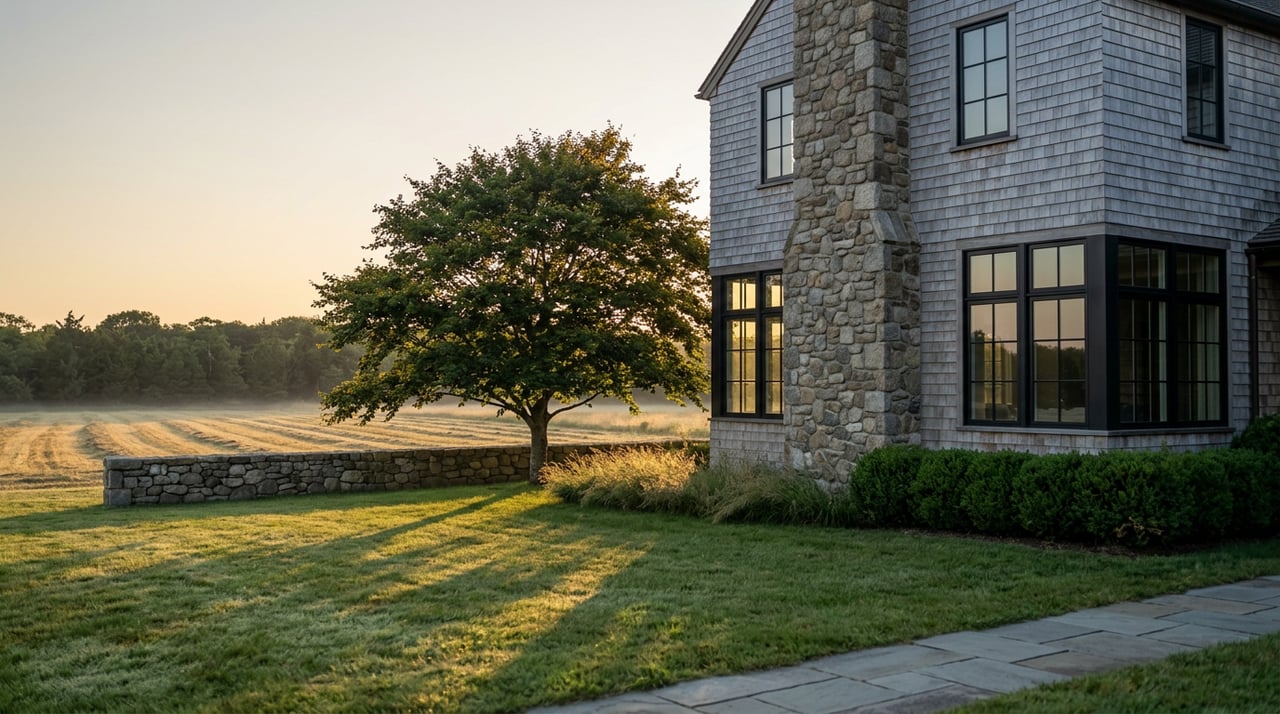
In June 2026, hedge fund manager Zach Schreiber put his oceanfront compound at 39 Fairfield Pond Lane on the market for $152.5 million, a number that would make it the highest home sale the East End has ever recorded if it closes at ask. A few miles inland, on Sagg Main Road, the same village's farmland changes hands for about $22,000 an acre, sold not to another buyer chasing a trophy but to the working farmers who till it.
Same village. Same dirt, broadly speaking. A price spread of roughly seven thousand to one.
That gap reflects the rights attached to each parcel. Farmland with development rights removed has a different value from land without that restriction. Understanding those differences helps explain what a buyer is paying for in Sagaponack.
Two acres, two prices
The clearest illustration sits on Sagg Main Road, where Jim and Jennifer Pike have run a farmstand for more than two decades. In 2010, as 27east reported, the Peconic Land Trust bought 7.6 acres of the Hopping family's farmland there for $6 million. Suffolk County and Southampton Town then paid $4.3 million for the development rights, stripping the land of any future residential value. What was left, once the rights were gone, sold back to the Pikes for $167,200 total, or about $22,000 an acre.
That is the restricted price: what protected farmland is worth to a farmer who can only ever farm it. The unrestricted price, when similarly protected land has changed hands to buyers who wanted the acreage for a lawn, a horse paddock, or an unbroken view rather than food production, has climbed as high as $300,000 an acre, pushing the average value of protected farmland on the South Fork above $100,000 an acre.
The Pikes' farm today totals about 27 acres around Sagaponack, producing sweet corn, tomatoes, and more than 30 other vegetables, flowers, and fruits. The farmstand is real, and it is not going anywhere. But the two prices attached to the ground beneath it are the mechanism every Sagaponack buyer is transacting against, whether they realize it or not. The farmland stays frozen at agricultural value. The buildable land next to it absorbs the scarcity that freezing creates.
How zoning shapes land use
Sagaponack's zoning, laid out in Chapter 245 of the Village Code, does the enforcing. The village is split into R-40, R-80, and R-120 residence districts, meaning minimum lot sizes of 40,000, 80,000, and 120,000 square feet, layered with an Open Space Conservation and Park District and Agricultural Overlay Districts that stack additional review on top of standard zoning.
The Agricultural Overlay District adds another layer of review. Planning Board site plan review may apply to building permit applications, and within the Agricultural Overlay District the board is required to weigh the loss of prime agricultural soils and the preservation of public vistas before it approves where a structure can sit. For a buyer assembling a large compound, those requirements can shape where structures may be placed.
Height is capped at 32 feet under what the code calls a pyramid law, a formula that ties a structure's allowable height to its distance from the property line. And on several of the village's most sought-after streets, the code removes an option most estate buyers assume is theirs by default: driveway entry gates and gateposts are prohibited on both sides of Sagg Main Street south of Montauk Highway, and on Hedges Lane, Personage Lane, Gibson Lane, Daniels Lane, Sagaponack Road, and Bridge Lane, all part of the village's Historic District.
How the oceanfront setback changed
None of this is static. The White Farm's history, as 27east reported, shows why. The 57-acre farm, founded in the 17th century by Ebenezer White, stayed in the family through the 20th century until Houston oil executive Tony Petrello began acquiring land and oceanfront cottages from them in the 1990s. What followed was years of litigation. In 2005 the Whites sold the development rights on the farmland to Southampton Town and the Peconic Land Trust for about $14 million. By 2019, the family had regained their 3.3-acre homestead parcel, while a 24-acre parcel of farmland and five oceanfront cottages passed to a Petrello-controlled entity.
As 27east reported, the village and the town scrapped a rule that had prevented construction within 125 feet of oceanfront dunes after a lawsuit over an application to enlarge one of those oceanfront cottages.
That history matters for anyone comparing a Sagaponack listing's stated setback distances against what they will actually be permitted to build. The version of the code you read today reflects two decades of these fights, and there is no guarantee it stops changing. Verifying current setback and site plan requirements directly, rather than assuming a static rulebook, is not optional due diligence in this village. It is the whole point.
Why the median doesn't mean what it says
Sagaponack sells so few homes in a given year that the reported median price can swing wildly depending on which two or three deals happen to close. That is worth sitting with before treating any single median figure as a market signal.
The scale of individual trades in Sagaponack helps explain why:
| Property | Price | Year |
|---|---|---|
| Barry Rosenstein's Further Lane assemblage | $147 million | 2014 |
| 39 Fairfield Pond Lane, Sagaponack (listed) | $152.5 million | 2026 |
A village where a single trophy closing can be tens of millions of dollars above or below the next one does not behave like a normal housing market when it comes to averages. Ira Rennert's Sagaponack estate, valued at $425 million, remains the standing benchmark for the priciest home in the Hamptons without having recently traded at all. When headline coverage cites a median price for Sagaponack, the useful question is not whether the number is accurate. It is how many transactions produced it, and whether one of them looked like the properties above.
What this means if you're comparing lots
If you are weighing a Sagaponack property against something in a neighboring village, a few questions do more work than the listing sheet:
- Is any adjacent open land classified as preserved farmland or open space, and has that classification been contested? The village saw exactly this fight in September 2025, as The East Hampton Star reported: residents asked the Southampton Town Board to reclassify an 8.3-acre preserved parcel across from Wölffer Estate Vineyard from farmland to open space. Sagaponack Mayor Bill Tillotson and village board member David McMillan Jr. opposed the change, and Sagaponack farmer Marilee Foster raised the concern that one reclassification could set a precedent for the rest of the town's Community Preservation Fund farmland.
- Does the parcel require Planning Board site plan review under the Agricultural Overlay District?
- Is the property on one of the streets where driveway gates are prohibited under the Historic District rules?
- What does the current setback requirement actually say, given that at least one prior version of the rule was successfully challenged in court?
Southampton Town is still an active buyer in this system. 27east reported that in 2025 it spent $58.11 million on preservation acquisitions, and the year before that, $69.255 million. Those purchases are one way the town shapes how land can be used.
A short FAQ
Does farmland next to my lot mean that land can never be developed? Not permanently, and not automatically. Development rights can be sold and land use can be restricted, but the classification itself has been contested before, as the 2025 Wölffer-area dispute shows. Confirm the current designation and its history rather than assuming it is settled.
What triggers Planning Board review on a larger property? Sagaponack has site plan review requirements for some building permit applications, with additional Agricultural Overlay District factors if the land sits within that district.
Why do reported median prices for Sagaponack vary so much between sources? Transaction volume is low enough that a single high-value closing, or the absence of one, can move the reported median by tens of millions in either direction within a year. Treat any single median figure as a snapshot of a handful of trades, not a stable trend line.
If you are trying to read a specific Sagaponack property against this system, rather than against a portal's median, that is the kind of comparison worth a direct conversation. Dennis Saglam works this market from the Douglas Elliman Sag Harbor office and can walk through a specific lot's zoning exposure, preservation history, and comparable trades. Schedule a confidential consultation to start.
This article is general information, not legal, tax or financial advice. Consult a qualified professional about your situation.
